Subwoofer Size Versus Room Volume: A Pairing Guide
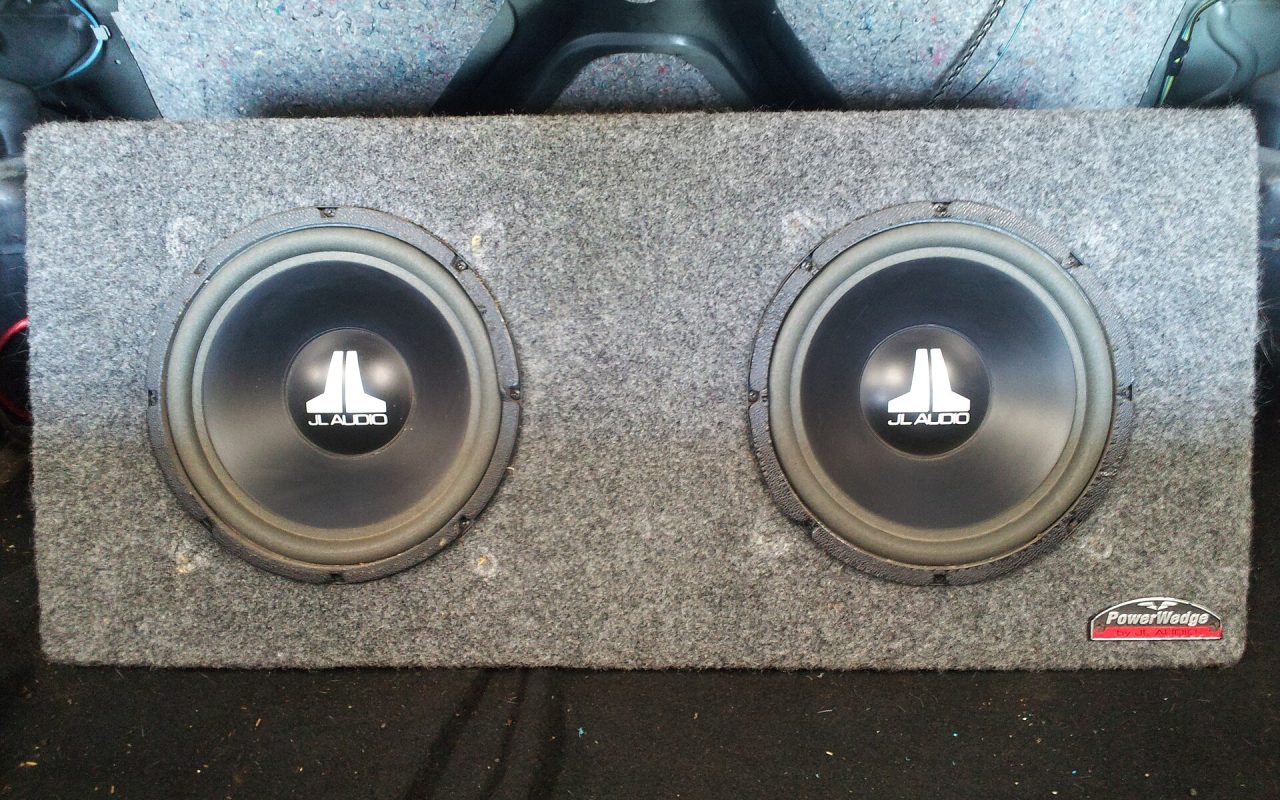
Subwoofer size is usually quoted as driver diameter, and it tells you less about performance than the cabinet volume and the amplifier behind it. What matters is how much air the subwoofer can move at the frequencies your room actually reinforces.
Option one: a single 10 inch sealed subwoofer
A 10 inch driver in a 25 litre sealed cabinet reaches about 35 Hz in a domestic room with room gain.
It suits rooms up to 30 cubic metres and pairs naturally with bookshelf speakers.
Sealed designs roll off gently, which makes them easier to integrate with mains.
Output below 30 Hz is limited, so the lowest organ pedals and explosions lose their floor.
For music-first systems in small rooms, that limitation matters less than it sounds.
Option two: a single 12 inch ported subwoofer
A 12 inch driver in a 60 litre ported cabinet with a 300 watt amplifier reaches 25 Hz with authority.
Ported designs add 3 to 6 dB of output around the tuning frequency, which is where film soundtracks put their energy.
The trade is a steeper rolloff below tuning, so a high-pass filter is advisable.
Group delay is also higher, which slightly blurs the transition with the mains.
For film in a 40 cubic metre room, a 12 inch ported design is the standard answer.
Option three: two smaller subwoofers
Two 10 inch subwoofers in opposing corners produce more even bass than one 15 inch subwoofer in a single position.
Placing two sources at different distances excites room modes less coherently, which flattens the response at the seat.
Total output is also 6 dB higher than one subwoofer, because two drivers moving in phase add.
Cost is roughly the same as one larger unit.
Two smaller subwoofers are the most reliable upgrade in a room with a bad bass problem.
Option four: a 15 inch or larger driver
A 15 inch driver in a large sealed cabinet moves four times the air of a 10 inch driver at the same excursion.
That displacement is what produces clean output at 20 Hz.
In a 30 cubic metre room, such a subwoofer is usually turned down to a fraction of its capability.
There is nothing wrong with that: headroom is not waste, it is the absence of compression.
The real cost is physical size, which in a shared room is often the deciding factor.
Option five: matching subwoofer to room volume numerically
A rough rule is one inch of driver diameter per 3 cubic metres of room volume, with a floor of 10 inches.
A 36 cubic metre room then suggests a 12 inch driver, which matches practical experience.
The rule assumes a normal ceiling and a sealed or well-tuned ported cabinet.
Rooms open to other spaces need 3 to 6 dB more output than the arithmetic suggests.
Treat the rule as a starting point and measure the result at the seat.
Option six: the boundary gain effect
Placing a subwoofer against a wall adds 3 dB; in a corner, up to 9 dB.
Corner loading therefore lets a smaller subwoofer produce the output of a larger one.
It also excites room modes harder, so the response becomes more uneven.
The compromise is to corner-load and then correct the peaks, rather than to buy a bigger subwoofer and fight the same peaks.
Placement changes output more than driver size does in most rooms.
Option seven: the subwoofer crawl
Place the subwoofer in the listening seat, play a bass-heavy track, and crawl along the floor.
The corner where the bass sounds most even is where the subwoofer belongs.
This method works because room modes are reciprocal.
It takes twenty minutes and outperforms most software predictions.
Repeat it after moving any large furniture.
Option eight: crossover and integration
A crossover at 80 Hz suits most systems with mains that reach 60 Hz.
Small satellites crossed at 120 Hz are audible as directional bass, so the subwoofer should then sit near the front.
Phase alignment matters more than crossover frequency: a subwoofer 180 degrees out of phase cancels the mains at the crossover.
Adjust phase while listening to a repeating bass line, not to a single tone.
Integration is a placement and phase problem far more than a level problem.
Option nine: what low frequency room behaviour does
Every room has modes at frequencies determined by its dimensions, and they create peaks of 10 to 15 dB at the walls and nulls at the centre.
A subwoofer cannot fix a null, because a null is a cancellation.
Moving the seat by 0.4 metres often does more than any equaliser.
Two subwoofers can fill a null that one cannot, because they excite the mode from two positions.
Treat the room as the largest component in the bass system, because it is.
Option eleven: servo and DSP subwoofers
A servo subwoofer measures cone motion and corrects it in real time, which reduces distortion at high excursion.
A DSP subwoofer instead applies parametric equalisation to flatten its own response in the room.
The first improves the driver; the second improves the interaction with the room.
In a room with a strong mode, the DSP version usually helps more.
Neither replaces placing the subwoofer where the seat measures best.
Option twelve: isolation from the floor
A subwoofer coupled rigidly to a timber floor transfers energy into the structure, which is heard as rattles elsewhere.
A decoupling platform of 50 millimetres of dense foam or a sprung base reduces that transfer noticeably.
It also slightly changes the response at the seat, usually for the better.
In an upstairs room, isolation is the difference between usable and unusable after ten in the evening.
Option thirteen: amplifier power and headroom
A subwoofer amplifier of 300 watts is generally enough for a domestic room, but the figure is meaningless without a distortion limit.
Cheap plate amplifiers quote peak power at ten percent distortion, which is audible as chuffing on transients.
Continuous power into the driver's impedance is the honest number.
A subwoofer that never sounds strained at your normal level has enough power, whatever the badge says.
Headroom is felt on the loudest moment of a film, not on the specification sheet.
Option ten: measuring before and after
A measurement microphone and free software will show the response at the seat in a few minutes.
Take a reading before buying anything, then again after placement changes.
Look for peaks above 10 dB and nulls deeper than 15 dB.
Those two numbers explain most of what people describe as boomy or thin bass.
Driver diameter is a starting point for matching a room, and the measurements at the listening seat are the only figures that describe the system you actually own.