Fixed Frame, Pull-Down or Painted Wall: Screen Options Compared
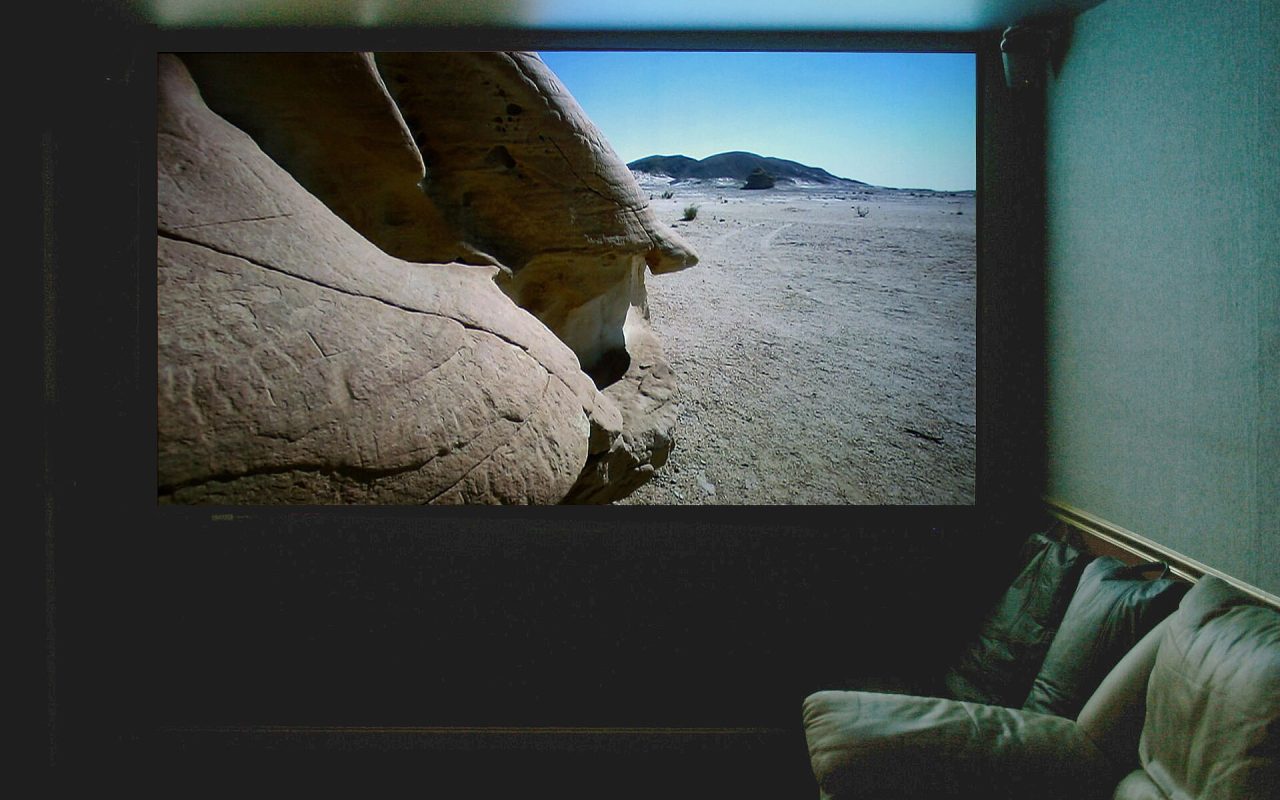
A projection screen is a tensioned surface whose flatness and reflectance determine how much of the projector's image survives the trip to your eyes. The three domestic options differ less in image quality than in how long they stay flat.
Option one: the fixed frame screen
A fixed frame uses a rigid aluminium frame and a material stretched by tension rods or springs.
Flatness is maintained indefinitely, which matters because a wave of 2 millimetres is visible as a shadow in bright scenes.
Installation requires wall space that will not be needed for anything else.
It is the cheapest way to get a genuinely flat large surface.
In a dedicated room, this is the default and the standard.
Option two: the tab-tensioned pull-down
A tab-tensioned screen uses side tension cords to keep the material flat when deployed.
It costs two to three times a fixed frame of the same size and adds a motor or a pull cord.
The mechanism can develop slack over years, and the case needs 100 millimetres of clearance above.
For a shared room where the screen must disappear, it is the best available compromise.
Non-tensioned pull-downs are cheaper and develop edge waves within a year.
Option three: a painted wall
A carefully prepared wall with screen paint costs almost nothing and can be very large.
Wall flatness is the limiting factor: plasterboard joints and paint texture both show.
The paint's gain is around 0.8 to 1.0 depending on the product, and colour neutrality varies.
It cannot be moved, cleaned deeply, or upgraded without repainting.
For a first projector in a rented flat, a painted wall is a reasonable start.
Option four: a stretched fabric screen
A fabric screen on a timber frame is a do-it-yourself option with good flatness if the fabric is taut.
Acoustically transparent spandex blends are popular for this, because they allow speakers behind.
The gain is low, around 0.6 to 0.7, which requires a brighter projector.
Seams are visible if the fabric is joined, so the roll width limits the size.
For a large acoustically transparent screen on a budget, this is the practical route.
Option five: the black border
Whatever the screen type, a black border improves perceived contrast.
On a fixed frame it is part of the frame; on a painted wall it must be added as tape or trim.
The border should be at least 75 millimetres wide and genuinely matt black.
Without it, a grey screen looks grey rather than black.
The border is the least expensive part of the screen and one of the most effective.
Option six: screen size versus wall space
A 120 inch 16:9 image is 2.65 by 1.49 metres, plus a border, plus frame thickness.
The wall needs 2.9 metres of width and 1.8 of height available.
In a room with a 2.4 metre ceiling, that leaves 0.6 metres for the screen's bottom edge and speaker positions.
Measure the wall before ordering the screen, not after.
Screen size follows wall dimensions more often than it follows ambition.
Option seven: acoustically transparent options
Woven screens allow a centre channel behind the image, which fixes the dialogue height problem.
They require a cavity of 600 to 900 millimetres behind the screen for the speakers and their ports.
The light loss is 5 to 10 percent, and high frequencies lose about 1 dB.
Perforated vinyl is cheaper and loses more light.
Where the front stage is being built from scratch, the transparent option is worth the planning.
Option eight: motorised screens and alignment
A motorised screen needs a limit switch set precisely, or it stops at a different height each time.
It also needs a power supply at the case, which means a cable run to the ceiling.
Drop distance must be measured from the case to the intended bottom edge.
Getting it wrong means the image lands half on the wall.
Motorised screens add convenience and three new failure points.
Option nine: cleaning and longevity
Fixed frames last decades with occasional dusting.
Pull-downs accumulate dust on the back surface, which then transfers to the front when rolled.
Painted walls can be repainted, which is both an advantage and a temptation to change the gain by accident.
Fabric screens cannot be cleaned at all.
Longevity favours the fixed frame in every comparison.
Option ten: the viewing angle reality
A fixed frame with a matt white surface holds brightness across 60 degrees of viewing angle.
High gain materials narrow that to 30 degrees, which matters in a room with a wide sofa.
Screen choice should account for where people actually sit, not for the centre seat alone.
A cheap screen with a wide angle beats an expensive one that only works in the middle.
Seating geometry decides screen material more than budget does.
Option eleven: mounting and wall construction
A 120 inch fixed frame weighs 10 to 20 kilograms and must be fixed into studs or masonry.
Plasterboard alone will not hold it, and a falling screen damages everything below.
A French cleat is the standard fixing and allows levelling after hanging.
Two people are needed for anything above 100 inches.
The wall's construction is part of the screen specification.
Option twelve: the installation sequence
Mount the projector and confirm the image size and position on the bare wall first.
Then order the screen to that measurement, adding the border width.
Hang the screen, then align the projector to the screen's edges rather than the reverse.
Finally set the lens shift and focus on a test pattern with fine text.
This order avoids buying a screen for an image the projector cannot produce.
Option fourteen: the screen that arrives wrinkled
Rolled screens ship in tubes and can develop creases in transit.
A crease in a vinyl surface never fully relaxes, and tensioning can make it worse.
Woven materials recover better because the weave distributes tension.
Inspect a delivered screen before installation, not after hanging it.
Transport damage is the most common reason a new screen is returned.
Option fifteen: upgrading the surface later
A fixed frame allows the material to be replaced on the same frame if a better surface becomes available.
A painted wall requires repainting the entire surface, with the risk of changing the gain.
A pull-down is a sealed unit and cannot be re-covered.
Modularity is a quiet argument for a frame-based screen.
Buying a frame once and material twice is cheaper than buying two complete screens.
Option thirteen: which to choose
Dedicated room with a permanent wall: fixed frame, matt white, black border.
Shared room that needs the wall back: tab-tensioned pull-down.
Speakers behind the image: woven acoustically transparent, fixed frame.
First projector, tight budget, rented room: painted wall with careful preparation.
The screen is the surface every image passes through, and flatness is the property that decides whether the money was well spent.