Screen Gain and Ambient Light: Comparing Four Screen Types
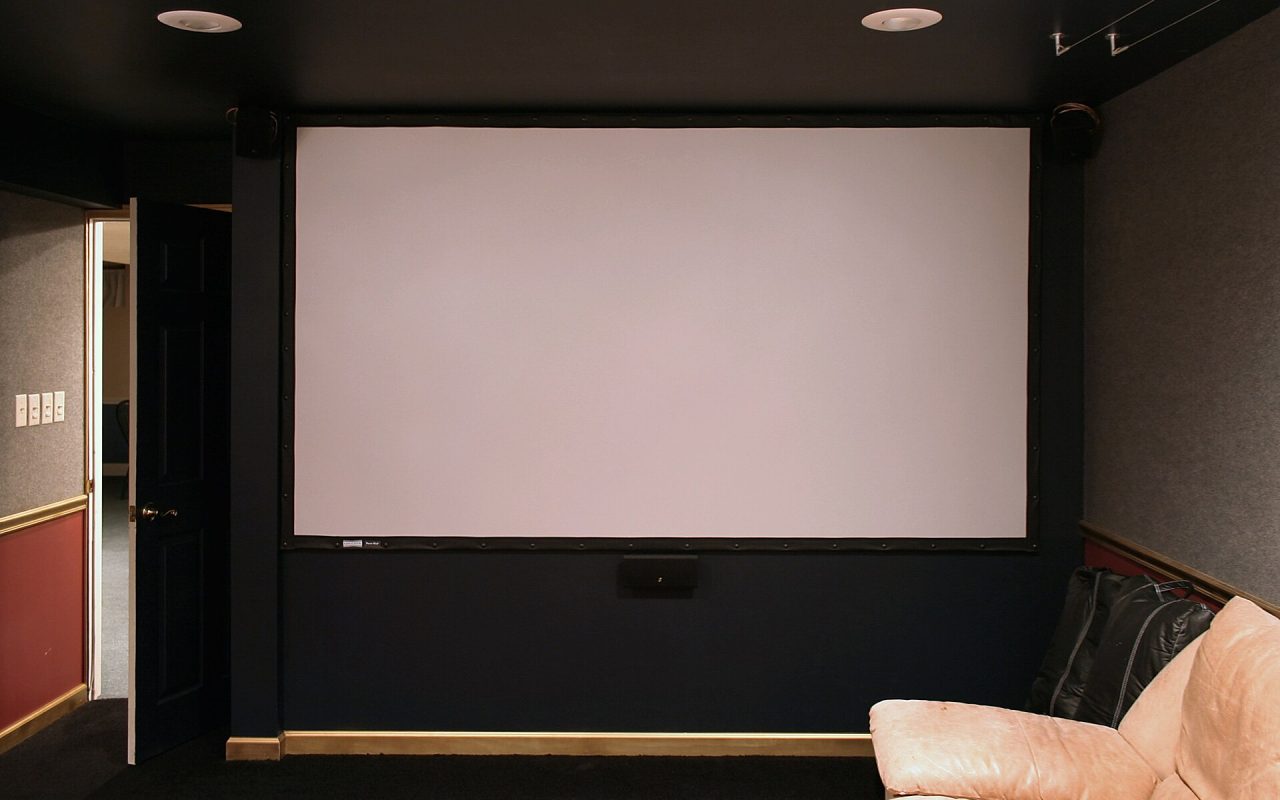
Screen gain is the ratio of light reflected toward the viewer compared with a perfect diffuse surface, and it always trades brightness against viewing angle. A gain of 1.0 reflects evenly in all directions; a gain of 1.5 sends more light forward and less to the sides.
Option one: matt white at gain 1.0
A matt white screen reflects light evenly and preserves colour neutrality.
It is the reference against which other screens are judged and the safest choice in a dark room.
Viewing angles stay wide, so seats at the sides see almost the same image as the centre.
Its weakness is ambient light, which washes it out quickly.
In a dedicated dark room, gain 1.0 is not a compromise at all.
Option two: grey screens at gain 0.8
A grey screen reduces the reflected light from the projector and from the room equally.
That lowers peak white but improves perceived black level, which is what most people notice in a lit room.
The effect is a contrast improvement at the cost of brightness, typically 20 percent.
It works best with a projector that has brightness to spare.
Grey is the standard answer for a living room with imperfect light control.
Option three: high gain at 1.3 to 1.8
A high gain screen concentrates light toward the axis, which allows a larger image from a dimmer projector.
The trade is a narrow viewing cone: at 30 degrees off axis, brightness can fall by a third.
High gain also amplifies any hotspot from the projector's lens and makes the screen's texture visible.
For a single central seat and a large image, it can be the right tool.
For a family seated across a sofa, it rarely is.
Option four: ambient light rejecting screens
An ALR screen has a microstructure that rejects light arriving from above and accepts light from the projector's angle.
In a room with windows and ceiling lights, it can triple the perceived contrast.
The rejection depends on the projector's angle, so it works with ultra short throw or with a steeply mounted long throw projector.
It also has a narrow viewing cone and a visible texture at close range.
ALR is a solution to a specific geometry, not a general upgrade.
Option five: the room's ambient light measurement
A cheap lux meter at the screen surface tells you how much light you are fighting.
Under 5 lux is effectively dark; 50 lux is a room with curtains; 200 lux is a lit living room.
A projector needs roughly 20 times the ambient light to hold contrast.
That arithmetic explains why a 3,000 lumen projector fails in a bright room with a white screen.
Measure the light before choosing screen gain.
Option six: screen size and brightness together
Brightness falls with the square of image area, so doubling the diagonal quarters the light per square metre.
A projector delivering 2,000 lumens on a 100 inch screen gives about 40 nits; on a 140 inch screen, about 20.
Cinema reference is 48 nits, which most domestic projectors only reach on modest screens.
Grey screens and high gain change the figure, but not the arithmetic.
Screen size is a brightness decision disguised as a seating decision.
Option seven: colour shift with gain
High gain surfaces can shift colour slightly toward green or blue at the edges.
Grey screens can dull saturation if the grey is not neutral.
A screen with a measured neutral response avoids both problems.
Manufacturers rarely publish spectral data, so reviews that measure it are valuable.
Colour accuracy is easier to preserve than to correct.
Option eight: fixed frame versus pull-down
A fixed frame screen is tensioned permanently and stays flat for years.
A pull-down screen is convenient and develops waves at the edges within a couple of years.
Waves produce visible shading in bright scenes and cannot be repaired.
In a dedicated room, fixed frame is the only sensible choice.
In a shared room, a tab-tensioned pull-down is the acceptable compromise.
Option nine: acoustic transparency and gain
A woven acoustically transparent screen loses 5 to 10 percent of light and slightly reduces high frequency sound.
Perforated vinyl loses more light and can produce visible moire at close range.
The gain loss is predictable and corrected by choosing a brighter projector.
The benefit is speakers behind the screen at the correct height.
Where the front stage matters, the light loss is worth accepting.
Option ten: the border and perceived contrast
A black border 75 to 100 millimetres wide around the image improves perceived contrast measurably.
It gives the eye a reference for black, which is why cinemas have always used one.
A screen without a border looks washed out even when it measures well.
The border is the cheapest contrast upgrade available.
Never buy a screen whose frame is white or silver.
Option eleven: screen material and cleaning
Vinyl surfaces can be wiped with a damp microfibre cloth; woven surfaces cannot be touched without damage.
Dust settles on horizontal surfaces and is invisible until the projector is on.
A screen in a room with a fireplace collects far more dust than one without.
Cleaning instructions should be read before installation, not after.
A damaged woven screen cannot be repaired, only replaced.
Option thirteen: the projector's own light spill
A projector throws a rectangle of light that is larger than the intended image, and the overspill lands on the wall around the screen.
A dark wall absorbs it; a white wall reflects it back and lifts the black level of the image.
Masking the overspill with black fabric is the cheapest contrast improvement available after light control.
In a dark room with a white wall, the spill often matters more than the screen's gain.
The wall around the screen is part of the screen system.
Option fourteen: gain and HDR tone mapping
High dynamic range content expects a peak brightness that domestic projectors cannot reach.
Tone mapping compresses the range, and the result depends heavily on the available nits.
A screen that loses 20 percent of the light forces more aggressive compression, which flattens highlights.
In HDR viewing, brightness on the screen matters more than in standard dynamic range.
Gain choices that were harmless with standard content become significant with HDR.
Option twelve: what to buy for a typical room
Dark room, controlled light, 100 to 120 inch image: matt white at gain 1.0 with a black border.
Living room with curtains and some spill: neutral grey at gain 0.8.
Bright room with a fixed projector position and a single central seat: consider ALR.
Any room where speakers belong behind the screen: acoustically transparent woven.
Screen gain is a trade between brightness and angle, and the room's light decides which side of that trade is worth taking.