First Reflection Points: Four Ways to Treat Them in a Living Room
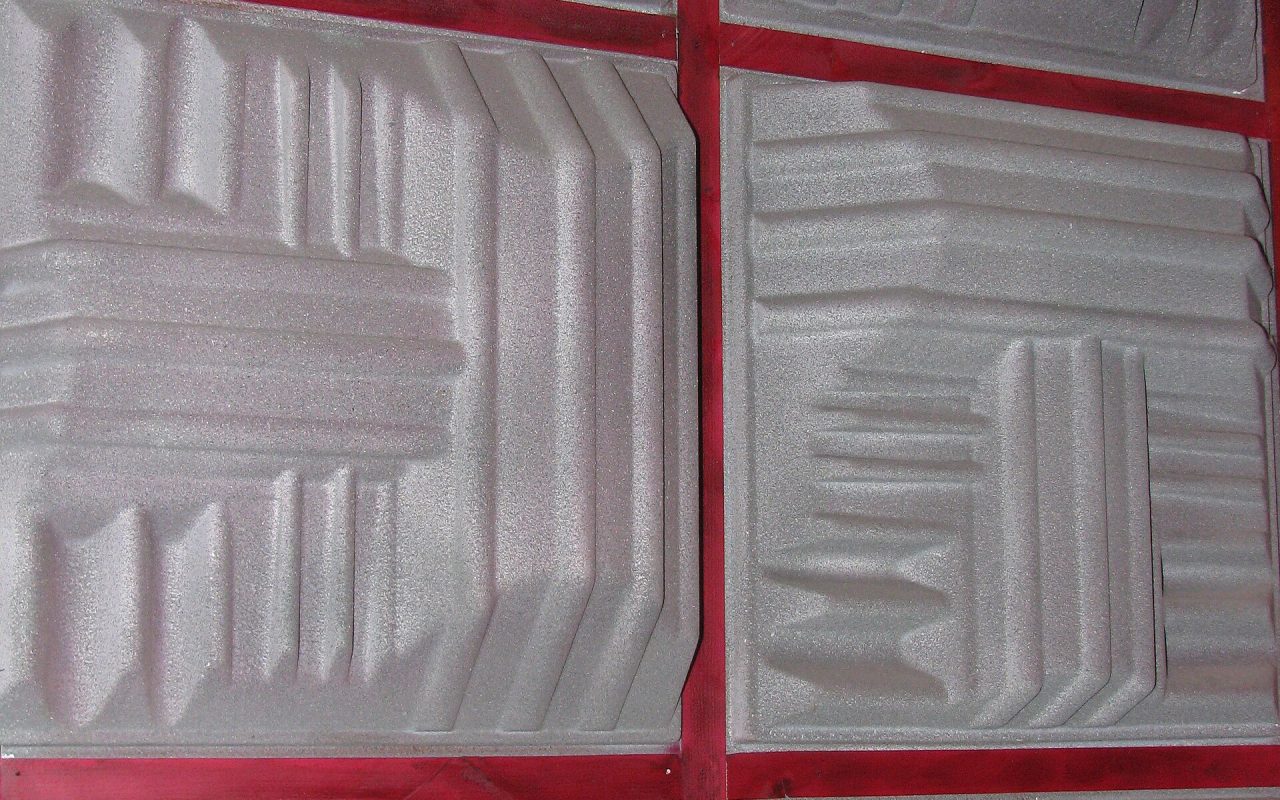
A first reflection point is the spot on a wall, floor or ceiling where sound from a speaker bounces once before reaching the listener. Those reflections arrive within a few milliseconds of the direct sound, and the ear fuses them with it rather than hearing them separately.
Option one: find the point with a mirror
Have someone slide a hand mirror along the side wall while you sit in the listening position.
Wherever you can see a speaker's tweeter in the mirror, that is a first reflection point.
Do it for both speakers and both walls, and mark the spots with tape.
The method is old, free and more accurate than most diagrams.
Marking the points before buying anything prevents treating the wrong place.
Option two: absorbing panels at the side walls
A panel of 50 millimetres mineral wool at each side reflection point reduces that early energy by 6 to 10 dB.
The effect is a sharper centre image and clearer dialogue, because the direct sound is no longer competing.
Panels should be at ear height and at least 600 by 1200 millimetres to cover the relevant frequencies.
Smaller panels work above 1 kHz and do little below it.
Absorption at the sides is the single most effective acoustic change in a domestic room.
Option three: diffusion instead of absorption
A diffuser scatters reflection energy in many directions rather than removing it.
The room keeps its liveliness and the image sharpens, which many listeners prefer to absorption.
Diffusers need 100 millimetres or more of depth to work below 1 kHz.
They also need distance: a diffuser within 1 metre of the ear sounds like a rough surface.
Where the room would feel dead with absorption, diffusion is the better tool.
Option four: heavy curtains over the reflection points
Velvet or triple-pleated curtains of 8 to 10 kilograms absorb mid and high frequencies usefully.
They need to hang 100 millimetres from the wall to have any effect below 500 Hz.
A curtain flat against plasterboard absorbs very little, whatever its weight.
The air gap is what makes the fabric work.
Curtains are the most domestically acceptable treatment available.
Option five: the floor reflection
The floor is a first reflection point that nobody notices because it is expected.
The bounce arrives 1 to 3 milliseconds after the direct sound and produces a dip around 200 Hz.
A thick rug 2 by 3 metres in front of the speakers reduces it substantially.
Underlay matters as much as the rug's pile.
The floor is treated with furniture more often than with acoustic products.
Option six: the ceiling reflection
The ceiling point sits midway between the speaker and the listener in plan view.
In a low room that reflection is strong and arrives early, blurring the vertical image.
A suspended cloud of 50 to 100 millimetres absorbs it without occupying floor space.
Clouds can also hide cabling and lighting.
The ceiling is the least contested surface for treatment in a shared room.
Option seven: the rear wall behind the listener
The rear wall reflects sound back into the listener's head from behind, which smears the front image.
Absorption there tightens the image and improves the sense of depth.
Diffusion there creates a sense of space if the wall is 2 metres or more behind the seat.
Within 1 metre, absorption is the only sensible option.
The rear wall matters more in small rooms than the side walls in some layouts.
Option eight: how much area is enough
Treating 15 to 25 percent of the total surface area produces a controlled room without deadening it.
In a 4 by 5 by 2.5 metre room, that is 4 to 6 square metres of treatment.
Four panels of 600 by 1200 millimetres cover 2.9 square metres, which is a reasonable start.
More treatment than that starts to remove the room's character.
Coverage should be planned in square metres, not in panel counts.
Option nine: measuring the effect
A measurement microphone at the seat before and after treatment shows the change in reverberation and in the impulse response.
A visible reduction in early reflections is the confirmation that the panel is in the right place.
Listening tests alone are unreliable, because expectation changes perception.
Twenty minutes of measurement prevents a month of rearranging panels.
Measurement also shows when enough is enough.
Option ten: the thickness question
A 25 millimetre panel absorbs above 1 kHz and reflects below 500 Hz.
A 100 millimetre panel absorbs down to 250 Hz.
Thickness matters more than surface area for low-mid frequencies.
Two 50 millimetre panels with a 50 millimetre air gap perform like one 100 millimetre panel.
Buying thicker panels is usually better than buying more thin ones.
Option eleven: placement mistakes
Panels placed behind the speakers do very little, because that wall is not a first reflection point.
Panels at head height on the rear wall do a great deal.
Panels arranged symmetrically look better and behave better, because the stereo image stays centred.
Asymmetry pushes the image toward the treated side, which is easy to hear and hard to fix later.
Symmetry is free and it should be the first rule of any treatment plan.
Option twelve: treatment that survives a living room
Printed canvas panels, fabric-wrapped frames and bookshelves all pass as furniture.
A 60 millimetre frame with printed fabric over mineral wool costs less than a commercial panel of the same performance.
Matching the wall colour makes the treatment disappear.
Household acceptance decides whether the panels stay installed.
The best treatment is the one that nobody asks you to remove.
Option thirteen: a treatment order that works
Side wall first reflection points, then the rear wall, then the ceiling, then the floor.
That order follows both audibility and domestic acceptability.
Measure after each stage and stop when the image stops improving.
Most rooms need two stages, not four.
Treatment is a sequence of small decisions, not a single purchase.
Option fourteen: what changes and what does not
First reflection treatment sharpens the image, clarifies dialogue and improves the sense of a stable centre.
It does not change bass response, which is a room mode problem.
It does not make a harsh speaker warm, though it can reduce the perceived brightness of a bare room.
Expectations should match the tool, because disappointment follows misplaced hope.
A first reflection point is a specific place with a specific job, and treating exactly that place is more effective than treating the room generally.